Nikolai Gogol
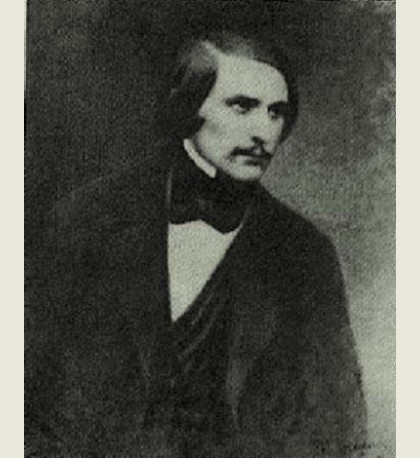
NIKOLAI VASILYEVICH GOGOL (born Yanovsky; since 1821 Gogol-Yanovsky) was a great Russian writer, playwright, poet, critic, and publicist.
He was born in the settlement of Velyki Sorochyntsi, Mirgorod Uyezd, Poltava Governorate, into a landowning family. He was named Nikolai in honor of the wonder-working icon of Saint Nicholas, kept in the church of the village of Dikanka.
The Gogols owned over 1,000 desyatinas of land and about 400 serfs. The writer’s paternal ancestors were hereditary priests, but his grandfather, Afanasii Demyanovich, left the clerical path and entered the Hetman’s chancery; it was he who added to the surname Yanovsky another one—Gogol—which was meant to demonstrate the family’s descent from the well-known 17th-century Ukrainian colonel Yevstafii (Ostap) Gogol (a fact, however, not sufficiently substantiated).
The writer’s father, Vasily Afanasyevich Gogol-Yanovsky (1777-1825), served at the Little Russian Post Office, resigned in 1805 with the rank of collegiate assessor, and married Maria Ivanovna Kosyarovskaya (1791-1868), who came from a landowning family. According to tradition, she was the first beauty of the Poltava region. She married Vasily Afanasyevich at the age of fourteen. Besides Nikolai, there were five other children in the family.
Gogol spent his childhood years in his parents’ estate of Vasilievka (also called Yanovshchina). The cultural center of the region was Kybintsy, the estate of D. P. Troshchinsky (1754-1829), a distant relative of the Gogols, a former minister elected district marshal (marshal of the nobility); Gogol’s father served there as secretary. Kybintsy had a large library and a home theater for which Gogol’s father wrote comedies, while also acting and conducting.
In 1818-19 Gogol studied together with his brother Ivan at the Poltava district school, and then, in 182
Books


Didn't find the book you were looking for?
