Ray Bradbury
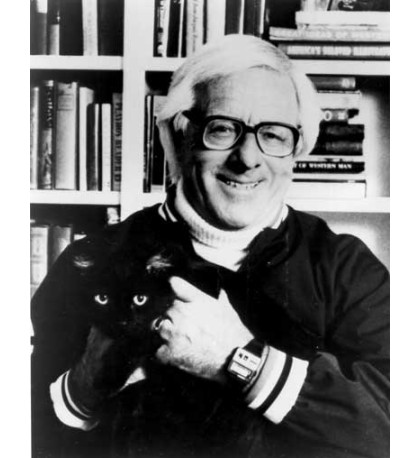
Ray Bradbury is an American science fiction writer. Critics classify some of his works as magical realism.
Ray Bradbury was born on August 22, 1920, in Waukegan, Illinois. He received his middle name, Douglas, in honor of the famous actor of the time, Douglas Fairbanks. His father was Leonard Spaulding Bradbury, a descendant of English settlers. His mother was Marie Esther Moberg, of Swedish origin.
In 1934, the Bradbury family moved to Los Angeles, where Ray lived his entire life. The writer’s childhood and youth were spent during the Great Depression; he had no means for a university education. Nevertheless, having decided at the age of almost 12 to become a writer, Ray followed that path with enviable persistence, never once considering any other profession. In his youth he sold newspapers, then lived for several years at his wife’s expense, until in 1950 his first major work, The Martian Chronicles, was finally published. Then, after writing the novel Fahrenheit 451 in 1953 and being published in the first issues of Playboy, his fame grew to worldwide proportions.
Ray Bradbury is often called a master of science fiction, one of the best science fiction writers, and the founder of many traditions of the genre. In fact, however, Bradbury is not a science fiction writer, since his work should be attributed to “serious,” nongeneric literature, and genuinely science-fiction works make up only a small part of it.
Bradbury’s works are for the most part short stories of a non-entertaining nature, containing brief sketches reduced to intensely dramatic, psychological moments, built mainly on dialogues, monologues, and the characters’ reflections. Despite his obvious talent for inventing various plots, often entertaining and original, the writer often limits himself to plotless sketches, highly metaphorical, full of hidden meaning or else carrying no definite semantic load at all. And even in his well-structured works, Bradbury can easily break off the narrative, avoid details, and leave the action at a moment of intense emotional climax. Nor can he be caught moralizing or imposing his point of view in practically any of his works: in 99% of them, the author remains “offstage.” The situation may develop as subjectively as one likes, but Bradbury
Books









Didn't find the book you were looking for?
