Simona de Bovuar
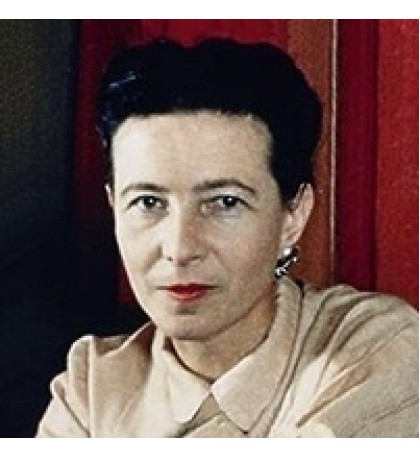
SIMONE DE BEAUVOIR — French writer and philosopher.
Born on January 9, 1908, in Paris, into a prosperous and by no means poor family, the daughter of a lawyer and a devout Catholic, she received a strict bourgeois upbringing. Her childhood, as she later admitted, was happy and cloudless.
After graduating from the Faculty of Philosophy, Simone de Beauvoir taught philosophy in Marseille throughout the 1930s. In the early 1940s she began a romance with the philosophy teacher Jean-Paul Sartre, who became a lifelong friend. As a writer, she took part with him in the Resistance movement. Their participation in these events is ambiguous and remains disputed by some of their contemporaries to this day, since they did not endure the hardships that befell those who fought in the Resistance with arms in hand. But de Beauvoir was left forever with a sense of guilt because she did not know hunger, was not cold, and did not suffer thirst. Morally, the lack of such experience oppressed her far more than her conscious refusal to have children. In the end, children were replaced for her by numerous books, in which she tried to understand herself and, for example, what children are as a form of the continuation of the human race.
Simone de Beauvoir wrote a great deal, but when taking up the pen she always sought to create only a significant, programmatic work, whether a novel, an essay, or an autobiographical narrative. She reflected on the fact that, unlike many living creatures, only human beings realize that their life is finite, that they are mortal. And during this brief life people do not have full freedom; they are always faced with the problem of responsibility in communication “with others.” The greatest difficulties arise in relations between the sexes. Simone de Beauvoir saw the possibility of agreement between them not in the sphere of sex and orientation toward the privileged status of man, but in a joint search for the meaning of life.
At the end of the twentieth century, de Beauvoir’s books devoted to the “third age” began to be recalled, where she managed to convey the splendor of life, the anxiety and longing of mature years, the scandalous collision of her own consciousness with the process of dying, of passing into nonbeing. Also recalled were the books in which
Books

Didn't find the book you were looking for?
