Stanislav Lem
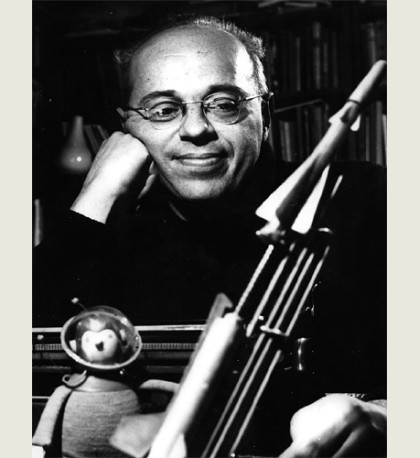
Stanislaw Herman Lem was a celebrated Polish writer, satirist, philosopher, science fiction writer, and futurologist. He was the author of the seminal philosophical work Summa Technologiae, in which he anticipated the creation of virtual reality and artificial intelligence, and also developed ideas of human autoevolution and the creation of artificial worlds. His books have been translated into 40 languages and published in a circulation of about 30 million copies.
Stanislaw Lem was born into the family of laryngologist Samuel Lem and Sabina Woller. His cousin, , was a well-known Polish poet and playwright. He studied medicine at Lviv University when the Second World War began. Despite his Jewish origins, the family managed to avoid deportation to the ghetto during the war thanks to forged documents. During the fascist occupation, Stanislaw worked as an auto mechanic and welder and took part in a resistance group against the Nazis.
In 1946, S. Lem repatriated to Kraków and continued studying medicine at Jagiellonian University. After graduating, he refused to take final exams, not wanting to become a military doctor, and received only a certificate of completion. He then worked as an assistant to Prof. Mieczysław Choynowski in the “Scientific Circle,” a collector of foreign scientific literature.
In his free time, Stanislaw Lem began writing stories in order to earn extra income during the difficult postwar period. His works were first published in 1946. Later this hobby became his main occupation: in 1948 he published an article criticizing Lysenko and was expelled from the scientific community. His first literary success came in 1951 after the publication of the novel Astronauts, which was repeatedly published abroad.
In 1953 he married Barbara Leśniak, who worked as a radiologist; in March 1968 they had a son, Tomasz. In 1973, S. Lem was awarded honorary membership in the American science fiction writers’ organization SFWA, the founder of the Nebula Award, from which he was expelled in 1976 for criticizing American science fiction literature, which he called kitsch and accused of poor
Books


Didn't find the book you were looking for?
