Taleb Nassim
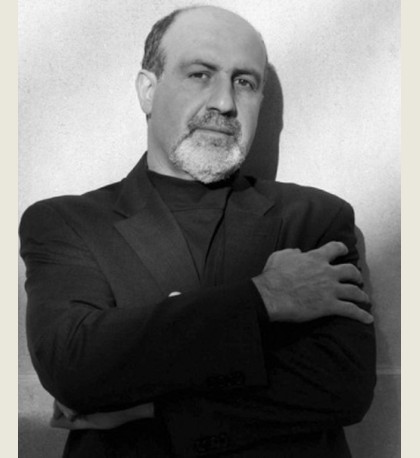
Nassim Taleb (January 1, 1960, Amioun, Lebanon) is an essayist, mathematician, and trader. His interests include epistemology (the branch of philosophy that studies the foundations of knowledge) and randomness, as well as interdisciplinary problems of uncertainty and knowledge, especially in connection with serious, difficult-to-predict events. He was among the first to become interested in the mechanisms of derivatives trading.
Nassim Taleb was born in 1960 in the Lebanese city of Amioun. His family was Orthodox Christian. During the civil war, which began in 1975, they were deported. Nassim’s father, Nicholas Taleb, was a doctor and oncologist and conducted anthropological research. Among his ancestors were politicians representing the interests of Lebanon’s Orthodox community. Thus, his maternal grandfather and great-grandfather were deputy prime ministers of Lebanon, his paternal grandfather held the post of chief justice, and as early as 1861 his great-great-great-grandfather served as governor of the semi-autonomous Ottoman province of Mount Lebanon.
Taleb held senior positions at brokerage firms in London and New York, and also worked on the exchange before founding his own hedge fund company, Empirica LLC (futures trading and options selling). He received an MBA from the Wharton School of Business and defended his doctoral dissertation at the University of Paris. He is the author of Dynamic Hedging, Fooled by Randomness, and The Black Swan: The Impact of the Highly Improbable.
Research and theories of randomness Calling himself an “empirical skeptic,” he believes that scientists, economists, historians, politicians, businesspeople, and financiers overestimate the possibilities of rational interpretations of statistics and underestimate the influence of inexplicable randomness in those statistics. Thus, Taleb continues the long tradition of skepticism professed by Sextus Empiricus, Al-Ghazali, Pierre Bayle, Montaigne, and David Hume, who believed that the past does not allow one to predict the future. Taleb is a follower of Karl Popper and argues that theories cannot be considered proven and can be used only conditionally.
At present, Taleb is engaged in research in the philosophy of randomness and the role of uncertainty in society and science, with an emphasis on the philosophy of history and the study of the role of major conting
Books

Didn't find the book you were looking for?
