Valter Benyamin
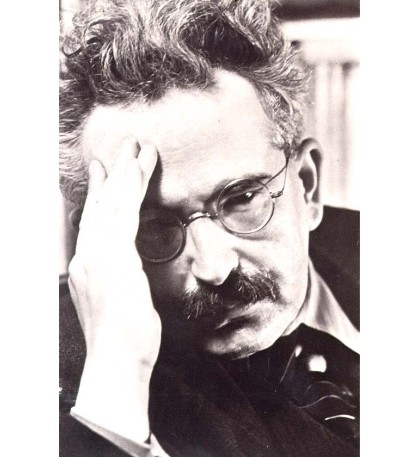
He was strongly influenced by Marxism, which he combined in a distinctive way with traditional Jewish mysticism, and was associated with the Frankfurt School in the sociology of art. His major work is The Work of Art in the Age of Mechanical Reproduction; he was the author of the now widely accepted idea of the aura, which a mass-reproduced masterpiece loses. A mediator of French culture, he translated Marcel Proust and Charles Baudelaire. A number of works, such as Berlin Childhood Around 1900, which anticipated the historical approach of the second half of the 20th century, were published posthumously.
The famous essay The Work of Art in the Age of Its Mechanical Reproduction (1936) in many respects echoes György Lukács’s The Theory of the Novel (1916) and Ernst Bloch’s The Spirit of Utopia (1918).
From 1917 to 1930 he was married to Dora Kellner. In December–January 1926–1927 he visited Moscow, where he wrote extensively, worked in the archives, and met Vladimir Mayakovsky and Bertolt Brecht. His impressions, mostly negative, were recorded in the so-called Moscow Diary.
As a Jew, antifascist, and left radical, after the Nazis came to power he emigrated to France, from where after the occupation of France in 1940 he intended to leave through Spain for the United States, having already sent much of his archive there. At the border crossing, the Spanish authorities, cooperating with the Gestapo, refused entry to the group of refugees to which Benjamin belonged. The philosopher then took his own life in the night of 27–28 September 1940 in the Hotel de Francia, poisoning himself with morphine.
The next day, under the impression of the tragedy, the Spaniards let the whole group through (it safely reached Lisbon on 30 September), and a few days later removed the restrictions altogether. Thanks to this, Benjamin’s like-minded associate Hannah Arendt was also able to cross the Spanish border and transport his Theses on the Philosophy of History to the United States. Some researchers doubt that he committed suicide, pointing out that Benjamin
Books






Didn't find the book you were looking for?
