George Orwell
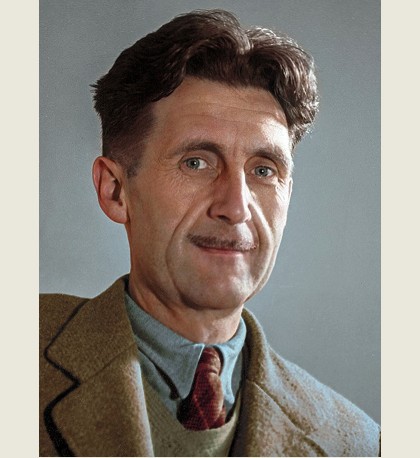
George Orwell is the pseudonym of the English writer and journalist Eric Arthur Blair (Eric Arthur Blair).
He was born on 25 June 1903 in Motihari (Bengal). His father, a British colonial official, held a minor post in the Indian customs administration. Orwell was educated at St. Cyprian’s School, received a named scholarship in 1917, and attended Eton College until 1921. From 1922 to 1927 he served in the colonial police in Burma. In 1927, while back home on leave, he decided to resign and take up writing.
Orwell’s early books — and not only his documentary ones — were largely autobiographical. Having worked as a dishwasher in Paris and a hop-picker in Kent, and having wandered through the villages of England, Orwell found material for his first book, Down and Out in Paris and London (1933). Burmese Days (1934) largely reflected the eastern period of his life. Like its author, the protagonist of Keep the Aspidistra Flying (1936) works as an assistant to a second-hand bookseller, and the heroine of A Clergyman’s Daughter (1935) teaches in shabby private schools. In 1936 the Left Book Club sent Orwell to northern England to study the lives of the unemployed in working-class districts. The direct result of this trip was the angry documentary book The Road to Wigan Pier (1937), in which Orwell, to the displeasure of his employers, criticized English socialism. In addition, during this trip he acquired a lasting interest in the products of mass culture, which is reflected in his now classic essays The Art of Donald McGill and Boys’ Weeklies.
The Civil War that broke out in Spain caused a second crisis in Orwell’s life. Always acting in accordance with his convictions, Orwell went to Spain as a journalist, but immediately upon arriving in Barcelona joined the guerrilla detachment of the Marxist Workers’ Party, the POUM, fought on the Aragon and Teruel fronts, and was seriously wounded. In May 1937 he took part in
Books




Didn't find the book you were looking for?
