Franz Kafka
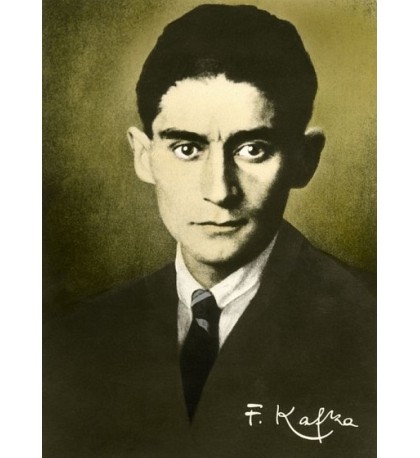
Franz Kafka was one of the major German-language writers of the 20th century, most of whose works were published posthumously. His works, permeated by absurdity and fear of the outside world and higher authority, and capable of arousing corresponding feelings of anxiety in the reader, are a unique phenomenon in world literature.
Kafka was born on 3 July 1883 into a Jewish family living in the Josefov district, the former Jewish ghetto of Prague (Bohemia at the time was part of the Austro-Hungarian Empire). His father, Hermann (Heinrich) Kafka, came from a Czech-speaking Jewish community in southern Bohemia and, from 1882, was a wholesale dealer in haberdashery goods. The writer’s mother, Julie Kafka (née Etl Levi), the daughter of a prosperous brewer, preferred the German language. Kafka himself wrote in German, although he knew Czech just as well. He also had a good command of French, and among the four people whom the writer, “without claiming to match them in strength and intellect,” felt to be “his own blood brothers,” was the French writer Gustave Flaubert.
The other three were Franz Grillparzer, Fyodor Dostoevsky, and Heinrich von Kleist. Although Jewish, Kafka was nevertheless practically unable to speak Yiddish and began to take an interest in the traditional culture of Eastern European Jews only in his twenties, under the influence of Jewish theater troupes touring Prague; his interest in studying Hebrew arose only toward the end of his life.
Kafka had two younger brothers and three younger sisters. Both brothers died before the age of two, before Kafka had turned six. The sisters were named Elli, Valli, and Ottla (all three died during World War II in Nazi concentration camps in Poland). From 1889 to 1893, Kafka attended primary school and then gymnasium, which he completed in 1901 by passing the baccalaureate examination. After graduating from Charles University in Prague, he received a doctorate in law (his dissertation supervisor was Professor Alfred Weber), and then entered government service as an official in the insurance department, where he worked in modest positions until his premature retirement in 1922 due to illness. Work was a secondary and burdensome occupation for the writer: in his diaries
Books
Didn't find the book you were looking for?
