Kurt Vonnegut
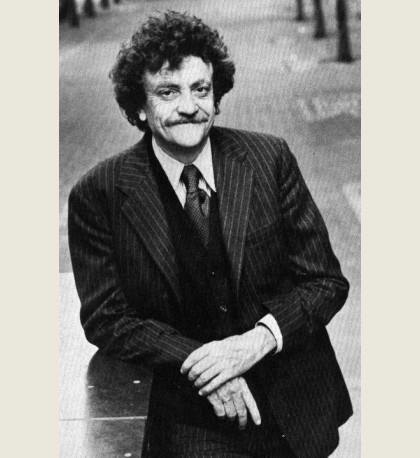
Kurt Vonnegut Jr. was an American writer, satirist, and artist, one of the most significant American writers of the 20th century.
He was born in Indianapolis, which became the setting for many of his novels, into the family of architect Kurt Vonnegut Sr. From 1941 to 1943, Vonnegut studied at Cornell University in New York State, where he wrote a column for the student newspaper Cornell Daily Sun and studied chemistry. After the bombing of Pearl Harbor, he voluntarily enlisted in the U.S. armed forces and took part in World War II.
In 1944, Vonnegut, then a private in the 423rd Infantry Regiment of the 106th Infantry Division, was captured during the German counteroffensive in the Ardennes. On February 13 and 14, 1945, while in captivity, he witnessed the bombing of Dresden by Allied aircraft. Kurt Vonnegut was among the seven American prisoners of war who survived that day in Dresden. His experiences were reflected in many of his works, especially in the novel Slaughterhouse-Five, or The Children’s Crusade, which brought the author fame. Vonnegut was liberated by Red Army troops in May 1945.
After returning from the front, Kurt Vonnegut entered the University of Chicago’s graduate program in anthropology. At the same time, while studying in graduate school, he worked as a police reporter for the Chicago news bureau. In 1947, he submitted a dissertation titled “An Unstable Relationship Between Good and Evil in Simple Tales,” which was unanimously rejected by the entire department (in 1971, the same department awarded Vonnegut a master’s degree in anthropology for his 1963 novel Cat’s Cradle).
After the dissertation failed, he moved from Chicago to Schenectady, New York, where he began working in the public relations department of General Electric. Kurt Vonnegut himself believed that he developed his distinctive style thanks to his work as a reporter.
Kurt Vonnegut considered himself a humanist and a socialist, a follower of the ideas of Eugene Debs. In 2003, he took part in the American Civil Liberties Union campaign in support of basic civil liberties and the strengthening of the Union’s role in defending these rights, during which George
Books




Didn't find the book you were looking for?
