Olard Dixon
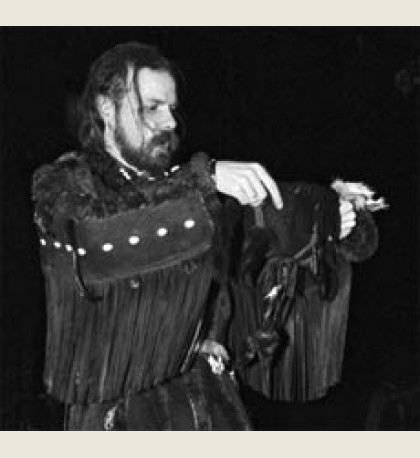
The maternal line of Olar d Elvil Dixon comes from the banks of the Mologa River, where the Rybinsk Reservoir now lies. This is an ancient site, sacred to many peoples, where the Ves people once lived. According to legend, the gates of Iria — paradise — are located there, and this was what Khan Batu sought. His great-grandmother was killed through the mediation of her own sister. The upbringing of his mother was taken over by an aunt who, in the 1930s, was given into service in a wealthy family. His paternal ancestors lived in the Chegorak steppes. His paternal great-grandfather was a miller. During the early years of Soviet power, he and his wife were cut down with a scythe by Red Army soldiers. His grandfather fled and settled in Tsaritsyno (then a suburb of Moscow), where he took up gardening. In the late 1960s he was arrested for illegal business activity and soon died.
O. Dixon inherited the blood of many peoples, mainly of the Ugric-Finnish and Turkic groups: Ves (the main branch), Karelian, Merya, and Tatar. The reconstructed genealogy dates back to the beginning of the 19th century, while the mythological one goes back into the depths of time. According to legends collected in the “Family Book,” the lineage begins with a woman who enters into an incestuous relationship with her brother. The brother learns of this and kills her together with the newborn son. From the spilled blood grows the plant porykh. A she-bear eats it and gives birth to a human child. Usynya — the City Bogatyr — kills the she-bear while hunting, and takes her human daughter as his wife. The girl cannot wear clothes and covers herself only with her long hair, because her body breaks out in sores and scabs from contact with them. For this reason she is given the nickname Parsha (“Scab”). From Parsha and the City Bogatyr the entire maternal line descends. The source of the lineage’s power is the Black Bull.
From childhood, O. Dixon displayed a wide range of abilities and curiosity, showing interest in prehistory, mysticism, astronomy, and the ritual practices of various tribes and peoples. In the early 1980s he studied judo in one of the sports
Books

Didn't find the book you were looking for?
